A different kind of Nov/Dec holiday - Camps are open for registration 🌳 You're invited to a 2-day trial to experience childhood the Laureum way - register your interest

Nature’s Classroom: Why Outdoor Learning Builds Confident, Curious Children
Discover how nature-based learning supports focus, confidence, and deep thinking in young children. Research-backed insights for parents seeking a richer early childhood experience.
Yeo Siqi
1/8/20263 min read
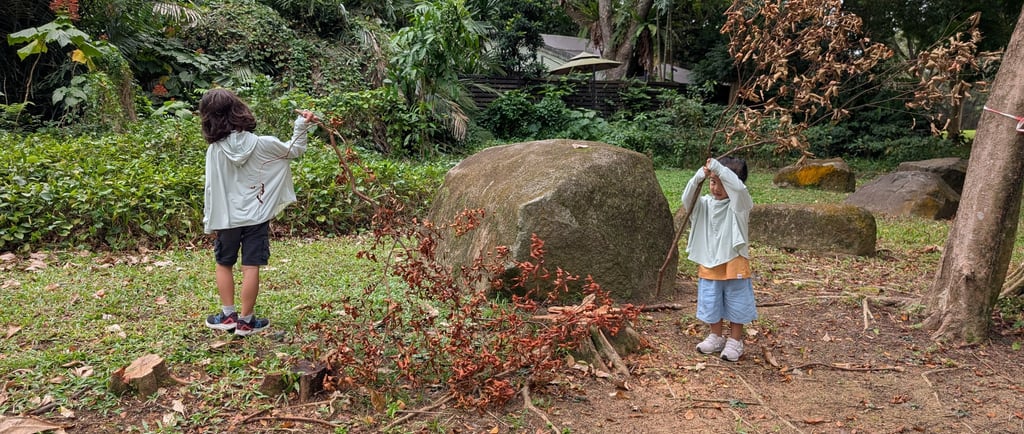
Have you ever watched a child’s eyes light up at the sight of a puddle, a patch of grass, or a stick that suddenly becomes a magic wand? What looks like simple play is actually deep, meaningful learning -- and there is science behind it.
In a world where childhood is increasingly scheduled and structured, nature offers something quietly powerful: space to breathe, time to wonder, and freedom to explore. This is what we call Nature’s Classroom.
What Nature Does for the Mind
Our brains are wired to respond to natural environments. Decades of research on Attention Restoration Theory show that nature helps restore focus and reduce mental fatigue by engaging the mind gently rather than demanding effortful concentration (Kaplan & Kaplan, 1989).
For children, this matters deeply. A child who feels calm and curious is more open to learning. Large-scale reviews confirm that time spent in nature supports attention, emotional regulation, and readiness to learn -- especially in young children (Kuo et al., 2019).
Put simply: nature does not distract children from learning. It prepares their minds for it.
Better Play, Deeper Learning
Not all play is equal. Research has consistently shown that children engage in richer, longer, and more imaginative play in natural environments than in built or highly structured ones (Prins et al., 2022).
Sticks, stones, leaves, slopes, and uneven ground invite children to invent, negotiate, and problem-solve together. These moments grow vocabulary, social skills, and flexible thinking -- foundations for literacy, numeracy, and collaboration later on.
When play is self-directed and open-ended, learning becomes meaningful rather than memorised.
Body and Mind -- Concurrent Growth
Movement is not separate from learning, it is learning.
Balancing on logs, climbing small inclines, navigating uneven paths: these experiences strengthen motor coordination, spatial awareness, and confidence. Studies show that children in nature-based play settings demonstrate greater independence, social competence, and emotional wellbeing compared to peers in conventional play environments (Dyment & Bell, 2006; Prins et al., 2022).
These are the skills that help children walk into future classrooms grounded, capable, and self-assured.
Social and Emotional Growth Happens Naturally
Outdoors, children are constantly practising life skills -- taking turns, resolving disagreements, caring for living things, and persisting through challenges.
A comprehensive review of nature play research found higher levels of prosocial behaviour, sustained engagement, and emotional regulation among children learning in natural settings. Educators also observed increased confidence and resilience over time (Prins et al., 2022).
These outcomes are not taught through instruction, they emerge through experience.
Why This Matters in Singapore
In a highly urbanised and achievement-oriented society like Singapore, early childhood education often leans towards structure and outcomes. Yet local initiatives such as NParks’ nature playgardens highlight the growing recognition that green spaces support focus, independence, and healthy risk-taking, even within dense urban environments (NParks, 2025).
Nature-based learning is not about rejecting academic readiness. It is about building the foundations that make academic learning meaningful, sustainable, and humane.
What Nature’s Classroom Really Means
It means seeing the world itself as a learning space:
A stick becomes geometry
A worm becomes science
A fallen log becomes balance, judgement, and confidence
A breeze becomes story and imagination
Nature does not replace school -- it strengthens the child who enters it.
🌱 Practical Takeaways: Bringing Nature’s Classroom Home
You do not need a forest to begin.
Families can support nature-based learning by:
Allowing unhurried outdoor time at playgrounds, parks or green corridors
Letting children climb, balance, and explore (within safe boundaries)
Encouraging curiosity with simple questions: “What do you notice?” or “What do you think might happen?”
Bringing home natural materials -- leaves, stones, seed pods -- for open-ended play
Resisting the urge to direct play; trust your child’s ideas
Small moments in nature, repeated often, create powerful learning.
References
Dyment, J. E., & Bell, A. C. (2006). Grounds for movement: Green school grounds as sites for promoting physical activity. Children’s Play, 10(2), 112–124.
Kaplan, R., & Kaplan, S. (1989). The experience of nature: A psychological perspective (p. 45). Cambridge University Press.
Kuo, M., Barnes, M., & Jordan, C. (2019). Nature and learning: Evidence for the role of nature in attention, emotional regulation, and learning engagement. Frontiers in Psychology, 10, 305.
NParks. (2025). Nature playgardens and child development in Singapore. International Journal of Early Childhood Environmental Education, 12(1), 40.
Prins, J., van der Wilt, F., van der Veen, C., & Hovinga, D. (2022). Children engage in higher quality play in nature than in non-nature settings. Children & Nature Network Research.
Connect
Childhood is not something to be hurried.
If you’re curious, we’d love to walk you through what learning can look like, gently.
© 2026. All rights reserved. Laureum Pte Ltd.